Understand AI for medical diagnosis, including validation evidence, FDA status, clinical supervision, and why patient-specific diagnosis should not rely on general chatbots.
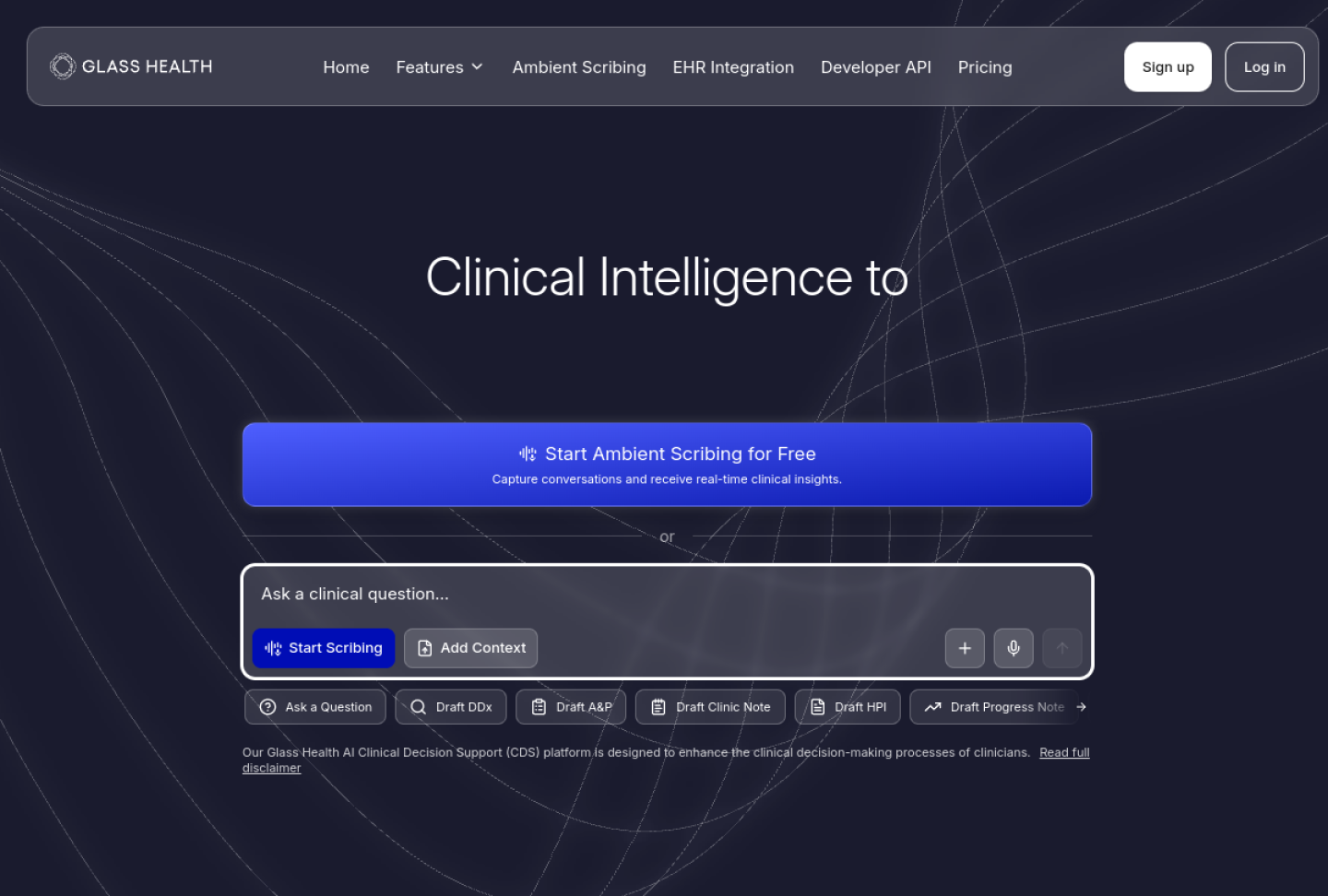
Representative source image: official Glass Health product page.
Quick answer: AI for medical diagnosis is high-risk because the output can affect patient care. Any diagnosis-support tool should be evaluated by intended use, validation evidence, patient population, clinician oversight, and regulatory status where applicable.
Who this guide is for
Clinicians and health technology buyers evaluating diagnosis support tools.
What makes this workflow different
Draws a hard line between diagnosis support and unsupervised diagnosis claims.
What to verify before using it
Verify whether the tool is regulated as a medical device for the intended use.
Review validation evidence for the exact specialty and patient population.
Define clinician responsibility for final diagnosis.
Set escalation paths for uncertain or high-risk outputs.
Do not use general AI chatbots as a replacement for medical diagnosis.
Risk level and safe use
Medical risk
High
Best first step
Write the workflow in one sentence, decide who reviews the AI output, and test with a small controlled pilot before expanding.
Recommended posture
Use AI as supervised workflow support. Verify sources, privacy, human review, and regulatory fit before relying on outputs.
Source-backed products for this workflow
These profiles are not rankings. They are starting points for checking vendor claims, privacy terms, FDA or regulatory posture, evidence, and workflow fit.
Glass states that it develops AI clinical decision support for differential diagnoses and assessment-and-plan drafting, with clinician review and evidence-backed recommendations.
Best for
Clinicians looking for guided clinical reasoning drafts with clinician review.
First check
Evidence sources and guideline maintenance process.
AvoMD describes a clinician-facing clinical decision support platform for care pathways, medical calculators, clinical algorithms, and AI-assisted workflows, with official materials emphasizing EHR integration, local content governance, and security review.
Best for
Organizations that want locally governed clinical pathways and calculators embedded into clinician workflows with reviewable source logic.
First check
Which pathway, calculator, Ask Avo workflow, or EHR integration is being deployed.
Ada describes enterprise symptom assessment, care navigation, clinical handover, and insights; its help and privacy pages state that Ada is not a substitute for medical advice and that Ada Assess is registered as an EU MDR Class IIa medical device, with jurisdiction-specific limits to verify.
Best for
Organizations that need structured symptom collection, acuity-aware routing, and handoff reports before clinical or access-team review.
First check
Whether the workflow uses consumer Ada, Ada Assess, care navigation, clinical handover, or partner-specific modules.
Find the best AI for medical workflows by matching the tool to documentation, questions, diagnosis support, research, coding, billing, imaging, or practice operations.