Evaluate AI for medical imaging by modality, intended use, FDA record, validation evidence, radiology workflow, and monitoring requirements.
Representative source image: official Aidoc product page.
Quick answer: AI for medical imaging includes computer vision tools that support detection, triage, segmentation, measurement, quality control, or interpretation of medical images. Buyers should verify FDA records, intended use, imaging modality, validation setting, and how clinicians review the output.
Who this guide is for
Radiology, cardiology, dental, telehealth, and federal health teams evaluating imaging AI.
What makes this workflow different
Connects imaging use cases with FDA-status verification and real deployment workflow checks.
What to verify before using it
Match the FDA-listed intended use to the real workflow.
Check modality, body region, specialty, and patient population.
Confirm how results appear in PACS, EHR, or reporting software.
Monitor performance after deployment.
Document who is responsible when AI and clinician interpretation differ.
Risk level and safe use
Medical risk
High
Best first step
Write the workflow in one sentence, decide who reviews the AI output, and test with a small controlled pilot before expanding.
Recommended posture
Use AI as supervised workflow support. Verify sources, privacy, human review, and regulatory fit before relying on outputs.
Source-backed products for this workflow
These profiles are not rankings. They are starting points for checking vendor claims, privacy terms, FDA or regulatory posture, evidence, and workflow fit.
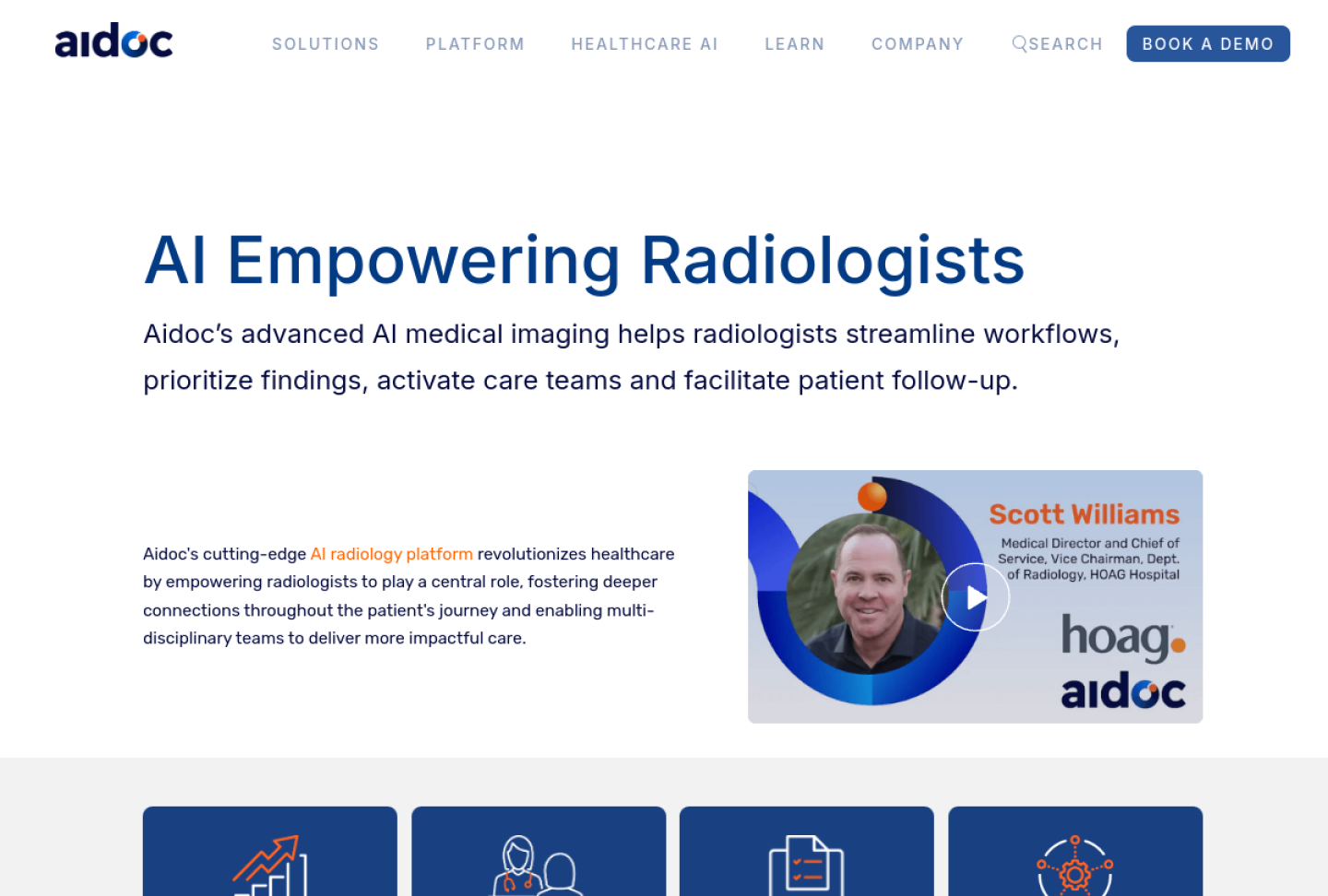
Aidoc describes radiology AI that helps prioritize findings, streamline workflows, activate care teams, and run through an aiOS platform; its FAQ and security pages point buyers to product-specific 510(k) notices, quality-system compliance, and cloud security review.
Best for
Health systems deploying multiple imaging AI algorithms and governance workflows.
First check
FDA-cleared algorithms that match your exact modality and use case.
ScreenPoint describes Transpara as a breast AI suite for detection, density, and temporal-comparison workflows and states that Transpara is CE marked and FDA cleared for 2D and 3D mammography; FDA records list Transpara 2.1.0 under K241831 and Transpara Density under K232096.
Best for
Breast screening programs comparing AI second-reader, case-scoring, density, and prior-comparison workflows for radiologist-reviewed mammography.
First check
Which Transpara module is in scope: Detection, Density, Temporal Comparison, or another breast AI workflow.
Koios describes Koios DS Breast as FDA-cleared and CE-marked smart ultrasound software for breast cancer risk assessment; FDA K212616 materials describe Koios DS as an AI/ML CADx adjunct for diagnostic ultrasound examinations of suspicious breast lesions and thyroid nodules.
Best for
Breast ultrasound teams evaluating adjunctive CADx support while preserving trained physician interpretation and BI-RADS workflow responsibility.
First check
Whether Koios DS Breast, Koios DS, or another module/version matches the intended breast ultrasound workflow.
Find the best AI for medical workflows by matching the tool to documentation, questions, diagnosis support, research, coding, billing, imaging, or practice operations.
Understand AI for medical diagnosis, including validation evidence, FDA status, clinical supervision, and why patient-specific diagnosis should not rely on general chatbots.